April 24, 2023

The Fine Art of Forgetting

Here’s a bit of advice for people like me who are really, really good at forgetting things while they’re running an RPG.

Consider the following scenario. The characters are doing X, and you made a note at some point that Y should happen. But then in the rewarding chaos of running a combat encounter, you forget the exact details of how Y works, so you run it wrong. There are lots of different scenarios that this encounter algebra can cover. Y can be the fine details of what an illusion can or can’t do, or misremembering a creature’s resistance to a damage type as immunity, or forgetting that an effect should have ended after just 1 round. It’s a complicated game, and forgetting things is easy.

First off, understand that it’s simple enough to just say to the players, “Sorry, I messed that up. Let’s just assume that Y happened in a different way than what we played out.” Everyone makes mistakes from time to time. Your players understand that. Especially if you’re playing with people you know well, no one’s going to get uptight or hold a grudge over you slipping up. (If they do get uptight or hold a grudge, you might be playing with the wrong people, but that’s another topic.)

Alternatively, though, it’s often possible — and remarkably easy — to roll with your mistakes and figure out ways to cover for them after the fact. 

Here’s an example near and dear to me. Every time I run troglodytes in combat (and I sincerely mean: every single time, for the last 40-odd years), I forget to ask for saving throws for their stench at the start of the fight. Every time. And usually when this happens, one of the players points this out in round 2 or 3, and I just say, “Oh, right. Let’s assume you saved earlier and we’ll start rolling now.”

But you can also embrace that mistake whole-heartedly, by saying words to the effect of: “Yeah, that’s unusual. These troglodytes aren’t exuding their normal stench, and you have no idea why.” 

Then at some point after the combat, you get to figure out why. Depending on the timing, you might have the entire length of the break between your game sessions to think of something.

Maybe these troglodytes are suffering some magical malady that’s weakening their tribe, putting the characters in a position to do them a favor by discovering the source of the malady and ending it. Maybe they’ve all become cultists of the god of hygiene. Who knows? 

Well, you know. Because you can pivot off of that innocuous error to make your the game’s narrative line up with the error any way you like.

Always remember how much of what’s fun in an RPG comes about because of randomness. Players and characters doing things that no one could possibly have predicted. And in the same way, the act of GMs making mistakes — the simple process of forgetting details in the way all GMs do from time to time — can create the same kind of fun by taking the session or the campaign as a whole in a different direction.


February 4, 2023

What’s the Story?

If you haven't seen it already, there's a new update on the CORE20RPG design and development blog: Skills and Story. And thinking about story in relation to skills — and specifically, thinking about how to describe the new setup for handling skill success in CORE20 — put me mind of the following.

• • •

When I talk about story in RPGs, and about story in D&D in particular, there’s often a response (usually measured; sometimes not) of: “But D&D isn’t a story game.” And that’s entirely true; but also not at all true, in the way of all conundrums that are less about fact and more about how we define the things we’re trying to factually assess.

For folks who define story games as games with specific mechanics for telling story, it’s absolutely true that D&D isn’t a story game. It doesn’t have those mechanics. No version of D&D has ever really worked on that level. But for folks (like me) who define story games as games in which a story can be unfolded and told, D&D has been a story game since its inception.

How do I know? I was there. I was there three thousand years ago, when Isildur took… Sorry, I mean I was there in the 1980s (which only sometimes seems like three thousand years ago), playing AD&D without so much as a standard mechanic for using skills unless you were playing a thief. And with those completely non-storytelling rules, I created stories with my friends that still resonate in my heart and mind to this day.

Were they good stories? Not always. But the characters we  created and the narratives we shaped never failed to hit all the touchstones for what story can and should be made of. Goals and desires. Conflict and tension. Secrets and revelation. Villainous monologues. Dramatically revealed character backstory. All that good stuff. 

For better or for worse, D&D is a game that lets people tell stories. And I like to think that the strength of the kinds of stories it tells — the kinds of allegorical tales that fantasy excels at — are a big part of the game’s enduring success. Much more so than mechanics, because there are many other games whose mechanics are much more elegant than D&D’s nearly-five-decades-old rebuilt war-game engine. 

Story ties to mechanics, to be sure. The randomness of combat and skill challenges can help create the uncertainty that defines the dramatic tension of an encounter or a scene, with the overall up-and-down movement of that tension tracking the shape of story as it unfolds. But even though the mechanics of D&D in its earliest forms ignored story completely, story became an unavoidable byproduct of the game nonetheless. And for me, that speaks to story as being the single most important part of the game’s ongoing legacy.

January 15, 2023

Three Pieces of Advice

I’ve been gaming since 1980, and I’ve been working on D&D since 2004, and I’m happy to tell people that I don’t feel like I have any more insight into what makes the game work than anyone else. Because more so than any other creative form, what makes roleplaying games work happens in the moment, forged where the creative energies of a bunch of people crash together to tell a story that couldn’t ever exist in any other way.

In general, I’m not ever about giving advice. I can talk to you about things that work for me in the game, and things that have entered the lexicon of D&D’s design and philosophical foundations. I can and do talk about things that I’ve seen work for other people, because learning what works for other people always invariably teaches me something about my own approach to the game. And I like talking about the evolution the game has made in multiple areas, edition by edition, that make it better at certain things than it was before. 

When it comes to regular advice, though, I try to avoid talking about things that other people have already talked about, unless I’ve got some specific insight or a fresh angle on it. Lots of D&D advice is pretty straightforward. And that’s totally cool. D&D and other RPGs rely on a constant stream of new players coming into their space, and every question that an experienced player has been collecting answers to for years is a question that a brand-new player somewhere is asking for the first time. 

In my experience, though, there are certain less obvious pieces of gaming advice that don’t get talked about as often as they should. So for this initial entry in Missives From Mooncastle, I thought I would talk about three of those things.

Watch, Listen, Engage 

Playing a roleplaying game is like no other kind of creativity or entertainment. An RPG is a storytelling machine, taking in the raw materials of narrative choices and dramatic possibilities that the GM and players create, and churning out amazing stories in emotionally resonant, finished form. But the fuel of that engine is you, the player — meaning your energy is the most important part of keeping the RPG engine running.

Watch the game before you, taking in all aspects of the narrative as it unfolds. Listen to what the other players are doing, especially when it’s not your turn. And engage in the story as strongly as you can while it develops. It’s easy sometimes for all of us to just want to focus on our own characters, especially when we’re roleplaying those characters well. But RPGs like D&D aren’t generally designed to spool the story thread of a single character. They weave story from multiple threads, and watching all those threads as they move, not just your own, puts you in the best position to help shape the pattern they create.

Failing for the Right Reasons

All RPGs are built around the idea of characters attempting actions, and resolving those actions as failure, success, or some relative degree of partial success in between. In the game, as in life, it’s much more fun to succeed than to fail. In real life, being in a position of never failing at anything would be pretty sweet, all things considered. But in the game, never failing can get boring pretty quickly, because without the risk of failure, the achievement of success can start to feel flat with nothing to judge it against.

One of the key aspects of D&D and games like it is the idea that failure shouldn’t be a static endpoint. A failed check should never mean that the adventure stops, just as a failed attack roll doesn’t mean a fight is unwinnable. All good GMs understand that when the characters fail, that just translates into an opportunity to succeed in a different way the next time. If an attempt to sneak in through the sally port of a castle fails, it gives you and the other characters a chance to think about other ways to make the same approach. A series of misses when attacking a heavily armored foe are an opportunity to think tactically about how to compromise that foes’ defenses with magic, by knocking them prone, or what have you.

This isn’t something a GM figures out automatically, of course. Like every part of running a game, understanding how to keep the game moving forward through failure takes time and practice. And one of the best ways for a GM to practice this is with the help of you and the other players as you focus on moving past failure with new ideas. Because every time you make a suggestion for a different approach to solving the problem at hand, you remind the GM that every problem can be solved in different ways — including ways the GM might not actually have thought about until you brought them up.

Empathy as Endgame

Empathy, as everyone knows, is the ability to mentally and emotionally put ourselves into someone else’s place in order to get a sense of how the world (or some specific aspect of it) looks and feels to them. By doing so, we gain understanding as we compare how the world looks and feels to others and how it looks and feels to us. Empathy is one of the core components of being human. Some (including me) might call it the most important component.

The concept of empathy is extremely important in fiction writing. It’s the foundation of our ability as readers to mentally and emotionally inhabit the characters we read in books or watch in movies, shows, and streams. And given that, it probably won’t surprise anyone when I say that empathy is one of the core foundations on which RPGs are built. When we create a character to portray in the game, we are putting ourselves emotionally and intellectually into that character’s place. We want to experience the world as they experience it — which becomes an even more exciting prospect the more different that world is than the world of our own lives.

As an added bonus, being cognizant of how empathy drives us while we’re within the game can make it easier to think about empathy in the space around the game. We can empathize with our fellow players, thinking about how the experience of playing the game feels to them, and how that experience might be different than our own. For experienced players, empathy helps make it clear when a newer player might need assistance that we can offer. As new players, empathy can help us remember that experienced players once had the same questions we have, as a means of making it easier to ask those questions without feeling self-conscious.

Understanding our own capacity for empathy is also the best way to recognize when certain players come up short in that department. The experienced players who make fun of newbies who ask questions. The players who insist that their experience of playing the game is the only legitimate one, as they make it clear they have no interest in the experience of anyone else. Those are players you want to avoid in your games, and engaging in empathy yourself lets you experience the game from those players’ point of view — and by doing so, makes it clear that the way they play the game isn’t worth your time.

January 13, 2023

Welcome!

This is the official intro post to the Missives From Mooncastle blog, the online home of the email newsletter of Insane Angel Studios and Scott Fitzgerald Gray.

Scott Who?

Scott Fitzgerald Gray (9th-level layabout, vindictive good) is a writer of fantasy and speculative fiction, a fiction editor, a story editor, and an editor and designer of roleplaying games — all of which means he finally has the job he really wanted when he was sixteen. His work in gaming covers three editions of the Dungeons & Dragons RPG, including working as an editor on the fifth edition Monster ManualDungeon Master’s GuidePlayer’s HandbookStarter Set, and Essentials Kit

All told, Scott has written or edited upwards of two hundred books, adventures, and articles for Wizards of the Coast, including writing Dead in Thay in the Tales from the Yawning Portal anthology and being managing editor and co-creative director for the Acquisitions Incorporated book from Wizards of the Coast and Penny Arcade. He’s written or edited for MCDM, Ghostfire Gaming, Schwalb Entertainment, Sly Flourish, Gamehole Publishing, Green Ronin, Frog God Games, and others, as well as for DragonDungeonDragon+, and Arcadia magazines. He also creates and publishes under his own Insane Angel Studios imprint, including the recent monstrous-advice-and-tools tome Forge of Foes, created with Mike Shea and Teos Abadía, and the CORE20 RPG — a new classless, freeform-character approach to story-focused d20 fantasy.

Scott shares his life in the Western Canadian hinterland with a schoolteacher, two itinerant daughters, and a number of animal and spirit companions. More info on him and his work (some of it even occasionally truthful) can be found on BlueSkyMastodon dice.camp, and Twitter (all @scottfgray), and by reading between the lines at insaneangel.com.

What to Expect

The Missives From Mooncastle newsletter covers a broad range of random ideas revolving around Scott’s love of D&D and fantasy gaming. Sometimes this means digging into game mechanics. Other times, it means talking about things we can learn from the older editions of the game that are all but unknown to most new players. Sometimes it’s about making up random adventure or encounter generators, new magic items, or mysterious dungeon maps. And a lot of the time, it’s just a lot of thinking about the unique nature of fantasy RPGs as a medium for shared storytelling.

The blog is updated with new newsletter material on the newsletter’s irregular schedule. But if you’d prefer to get Missives From Mooncastle delivered straight to your inbox, you can subscribe!

The Old Lore

If you glance at the Blog Archive sidebar to the right of the page, you’ll note that even though this is the official intro post to the Missives From Mooncastle blog, there are a bunch of older entries. These are a selection of RPG-themed entries from Scott’s no-longer-extant personal blog, more details of which can be found here.

December 20, 2021

Cash Grab

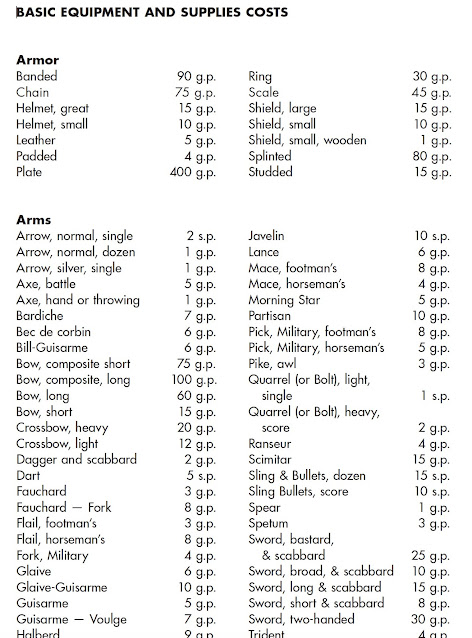
Thinking about D&D economics (as one does), and I remembered a fact that doesn’t get mentioned enough. The economy of the game as it’s defined by the basic equipment tables is intentionally borked. And that’s before even thinking about expensive spell components and magic items, which are even more borked.

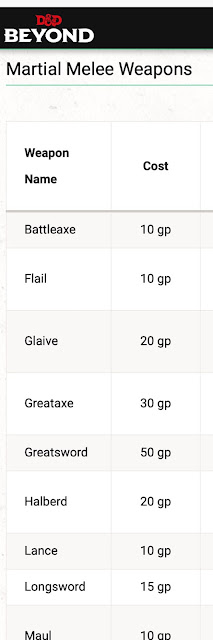
Consider if you will the humble longsword. For five editions now, a longsword has cost 15 gp. And most of the other items in the standard 5e equipment lists are still in the same general-cost ballpark as their AD&D equivalents.


A screenshot of part of the “Martial Weapons Table” from D&D Beyond, noting that a longsword costs 15 gp.


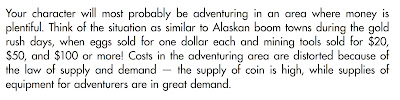
The problem is that the AD&D pricing that every edition since then has run with is explicitly called out as unnaturally expensive. And no newer version of the game has ever really done anything about that. From the same AD&D “Players Handbook” equipment page as above: 

From the 1e AD&D “Player’s Handbook”: “Your character will most probably be adventuring in an area where money is plentiful. Think of the situation as similar to Alaskan boom towns during the gold rush days, when eggs sold for one dollar each and mining tools sold for $20, $50, and $100 or more! Costs in the adventuring area are distorted because of the law of supply and demand — the supply of coin is high, while supplies of equipment for adventurers are in great demand.”

So D&D has always effectively had two economies — one for player characters, and one for everyone else. But unless you’re playing a game in the gold-rush-frontier milieu that A&D assumed was the default, there really isn’t any reason for that.

(Archive post from the personal blog.)

November 6, 2021

Soulstones

I renamed phylacteries as “soulstones” in my own games about five minutes after I became aware that “phylactery” was a word referring to an actual thing in the real world of contemporary faith, and not a relic of a dead mythology, as my very white, very Anglo-Saxon, very atheist-but-effectively-Protestant-by-osmosis self had assumed was the case when I first read the word in the AD&D Dungeon Master’s Guide

I swapped the name “golem” for “animata” for similar reasons. I’m in the process of renaming nagas and rakshasas and angels and other creatures in my own game likewise. I did these things because changing names in a game is dead easy. Figuring out how things work, figuring out how rules balance, figuring out the best way to present mechanics and lore — that can be tough.  

Changing a name, though? It’s nothing.

I’ve retroactively changed the names of NPCs in my games. I’ve changed the names of classes and monsters. I’ve changed the names of cities, nations, and historical periods when I realize there’s a name I like better for something than the name I first chose. It’s a non-event every time. 

So the idea that anybody would get bent out shape over acknowledging that the use of “phylactery” by D&D and its progeny games is culturally problematic makes me wonder what exactly it is they’re getting bent about.

(Archive post from the personal blog.)

September 21, 2021

What’s In a Name?

Need a D&D fantasy name in a hurry?! Turn any real word into a fantasy name in three simple steps!

  1. Turn any y’s into i’s.
  2. Turn any one other vowel into a y, or add an e to make it a double vowel, or make an e into ae.
  3. Throw a silent h in there somewhere.

You’re whaelcyme.

(Archive post from the personal blog.)