January 13, 2023

Welcome!

This is the official intro post to the Missives From Mooncastle blog, the online home of the email newsletter of Insane Angel Studios and Scott Fitzgerald Gray.

Scott Who?

Scott Fitzgerald Gray (9th-level layabout, vindictive good) is a writer of fantasy and speculative fiction, a fiction editor, a story editor, and an editor and designer of roleplaying games — all of which means he finally has the job he really wanted when he was sixteen. His work in gaming covers three editions of the Dungeons & Dragons RPG, including working as an editor on the fifth edition Monster Manual, Dungeon Master’s Guide, Player’s Handbook, Starter Set, and Essentials Kit. 

All told, Scott has written or edited upwards of two hundred books, adventures, and articles for Wizards of the Coast, including writing Dead in Thay in the Tales from the Yawning Portal anthology and being managing editor and co-creative director for the Acquisitions Incorporated book from Wizards of the Coast and Penny Arcade. He’s written or edited for MCDM, Ghostfire Gaming, Schwalb Entertainment, Sly Flourish, Gamehole Publishing, Green Ronin, Frog God Games, and others, as well as for Dragon, Dungeon, Dragon+, and Arcadia magazines. He also creates and publishes under his own Insane Angel Studios imprint, including the recent monstrous-advice-and-tools tome Forge of Foes, created with Mike Shea and Teos Abadía, and the CORE20 RPG — a new classless, freeform-character approach to story-focused d20 fantasy.

Scott shares his life in the Western Canadian hinterland with a schoolteacher, two itinerant daughters, and a number of animal and spirit companions. More info on him and his work (some of it even occasionally truthful) can be found on BlueSky, Mastodon dice.camp, and Twitter (all @scottfgray), and by reading between the lines at insaneangel.com.

What to Expect

The Missives From Mooncastle newsletter covers a broad range of random ideas revolving around Scott’s love of D&D and fantasy gaming. Sometimes this means digging into game mechanics. Other times, it means talking about things we can learn from the older editions of the game that are all but unknown to most new players. Sometimes it’s about making up random adventure or encounter generators, new magic items, or mysterious dungeon maps. And a lot of the time, it’s just a lot of thinking about the unique nature of fantasy RPGs as a medium for shared storytelling.

The blog is updated with new newsletter material on the newsletter’s irregular schedule. But if you’d prefer to get Missives From Mooncastle delivered straight to your inbox, you can subscribe!

The Old Lore

If you glance at the Blog Archive sidebar to the right of the page, you’ll note that even though this is the official intro post to the Missives From Mooncastle blog, there are a bunch of older entries. These are a selection of RPG-themed entries from Scott’s no-longer-extant personal blog, more details of which can be found here.
December 20, 2021

Cash Grab

Thinking about D&D economics (as one does), and I remembered a fact that doesn’t get mentioned enough. The economy of the game as it’s defined by the basic equipment tables is intentionally borked. And that’s before even thinking about expensive spell components and magic items, which are even more borked.

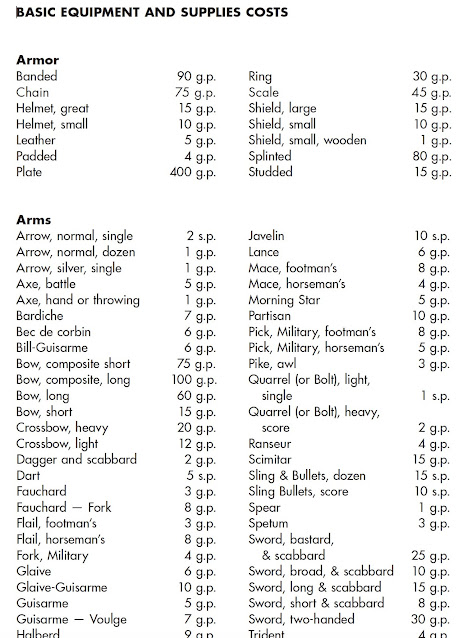
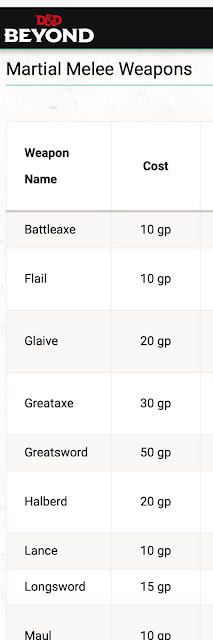
Consider if you will the humble longsword. For five editions now, a longsword has cost 15 gp. And most of the other items in the standard 5e equipment lists are still in the same general-cost ballpark as their AD&D equivalents.


A screenshot of part of the “Martial Weapons Table” from D&D Beyond, noting that a longsword costs 15 gp.


The problem is that the AD&D pricing that every edition since then has run with is explicitly called out as unnaturally expensive. And no newer version of the game has ever really done anything about that. From the same AD&D “Players Handbook” equipment page as above: 

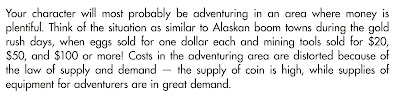
From the 1e AD&D “Player’s Handbook”: “Your character will most probably be adventuring in an area where money is plentiful. Think of the situation as similar to Alaskan boom towns during the gold rush days, when eggs sold for one dollar each and mining tools sold for $20, $50, and $100 or more! Costs in the adventuring area are distorted because of the law of supply and demand — the supply of coin is high, while supplies of equipment for adventurers are in great demand.”

So D&D has always effectively had two economies — one for player characters, and one for everyone else. But unless you’re playing a game in the gold-rush-frontier milieu that A&D assumed was the default, there really isn’t any reason for that.

(Archive post from the personal blog.)

November 6, 2021

Soulstones

I renamed phylacteries as “soulstones” in my own games about five minutes after I became aware that “phylactery” was a word referring to an actual thing in the real world of contemporary faith, and not a relic of a dead mythology, as my very white, very Anglo-Saxon, very atheist-but-effectively-Protestant-by-osmosis self had assumed was the case when I first read the word in the AD&D Dungeon Master’s Guide. 

I swapped the name “golem” for “animata” for similar reasons. I’m in the process of renaming nagas and rakshasas and angels and other creatures in my own game likewise. I did these things because changing names in a game is dead easy. Figuring out how things work, figuring out how rules balance, figuring out the best way to present mechanics and lore — that can be tough.  

Changing a name, though? It’s nothing.

I’ve retroactively changed the names of NPCs in my games. I’ve changed the names of classes and monsters. I’ve changed the names of cities, nations, and historical periods when I realize there’s a name I like better for something than the name I first chose. It’s a non-event every time. 

So the idea that anybody would get bent out shape over acknowledging that the use of “phylactery” by D&D and its progeny games is culturally problematic makes me wonder what exactly it is they’re getting bent about.

(Archive post from the personal blog.)

September 21, 2021

What’s In a Name?

Need a D&D fantasy name in a hurry?! Turn any real word into a fantasy name in three simple steps!

  1. Turn any y’s into i’s.
  2. Turn any one other vowel into a y, or add an e to make it a double vowel, or make an e into ae.
  3. Throw a silent h in there somewhere.

You’re whaelcyme.

(Archive post from the personal blog.)

November 7, 2019

Ability Check

People keep having conversations about ability scores in D&D, and why they don’t get nuked in favor of just using ability modifiers, and I keep struggling to come up with a quick precis of why I like ability scores, even as I acknowledge their limited purpose these days.

And then it hit me that the following might work: Ability scores are to ability modifiers as a character’s height and weight are to their size.

Which is to say, size and ability modifiers are game things. They have mechanical import and meaning. Height, weight, and ability scores are the more nebulous “statistics” from which the mechanical game things are defined.

The mechanical things are of primary importance in the game. Your ability modifiers define what your character can do; your size defines when you need to squeeze, and whether you can be swallowed by a giant frog. But on rare occasion, the more nebulous statistics underlying the mechanical thing come into play. Your Strength score determines what heavy armor you can wear. Likewise, if a magical effect enlarges you while you’re climbing up a rope, your weight might determine whether the rope breaks.

Certainly, it would be easy to remove height and weight from the game, saying that size can cover any of the times it’s needed. Likewise, heavy armor could have a Strength modifier prerequisite. But height, weight, and ability scores all seem like useful ways to help define a character beyond their modifiers and mechanical statistics. They might not be important as far as the rules go, but for me at least, they’re an important part of how a character feels.

(Archive post from the personal blog.)

January 6, 2017

You Are Welcome Here

For me, the issue of gender and inclusivity in games isn’t always about sexuality or gender issues per se. It’s about acknowledging what your narrative choices say about the world you’re creating, and about the people in that world. And with respect (and in response to some discussions taking place elsewhere), I think people who say, “I would include LGBTQ content in my game if I had those people at my table” are missing a larger point.

In a (stereo)typical FRPG setup, if I say, “The owner of the inn welcomes you, introducing you to his wife where she works behind the bar…”, it says something about the world of my game. It’s probably not intentional, because we create these narrative moments by instinct, and our instincts are honed by our own experience of living in a world where men own things and women work for men. But contrast that to “The owner of the inn welcomes you, introducing you to her husband where he works behind the bar…” Because that says something slightly different — and, in my view, something important — about the world of my game. Just as “The owner of the inn welcomes you, introducing you to his husband where he works behind the bar.…” says something more important still.

The thing I hope that last one says to LGBTQ players is “You are welcome here.” The thing I hope it says to non-LGBTQ players is “This is the world you’re a part of.” Even over and above creating games and game narrative geared toward LGBTQ characters and players (because that’s obviously important), this is big part of what inclusivity means to me.

(Archive post from the personal blog.)

August 12, 2015

Lights, Camera, Roll for Initiative

I confess that I haven’t seen any of the previous D&D movies (because I have way too many other things I need to watch that don’t apparently suck). But on the subject of the current hysteria regarding a new film and the possibility that said film will/won’t suck, and how to make sure it does/doesn’t, I have what I suspect is a minority view.

I don’t think there should be a D&D/Forgotten Realms movie. Like, not now, not ever, not under any circumstances. Because no matter what approach is taken to a film, no matter how objectively good it might actually turn out to be, D&D is such a vast creative phenomenon that it’s impossible for a work as brief as a feature film to even begin to capture what the game means to those who know it, and to overcome the sense of “Why should I watch a movie about this nerd game?” on the part of those who don’t know it.

Instead, there should be a D&D/Forgotten Realms cable TV series. An ongoing, slow-building, visually and viscerally compelling narrative that can take advantage of the episodic nature of that medium. Because only a medium that has the space to fully explore a world and the sense of imagination at the heart of that world is going to allow the breadth of storytelling that can do justice to the lore of the Realms, and to the sense of what the game is and what it means to the people who play it.

(Archive post from the personal blog.)